
Industry News
Construction Material Availability & Procurement Risk
Construction activity and material availability aren't necessarily moving in the same direction.
EvaE Consulting · · 1 min read

Construction activity and material availability aren't necessarily moving in the same direction.
New UK government statistics provide an interesting snapshot of the current market.
In June 2026, deliveries of bricks were 16.3% lower than a year earlier, while concrete block deliveries were 12.3% lower.
At the same time, the construction material price index for All Work increased by 6.0% year-on-year.
That is a more nuanced picture than simply saying construction costs are rising.
Supply volumes for some fundamental materials are weakening while material prices remain elevated. And the headline 6.0% figure itself hides much larger movements in individual products, with fabricated structural steel, rigid pipes and fittings, and aggregates showing substantially different price movements.
For MEP and construction delivery, this matters because procurement risk isn't defined by price alone.
Availability, manufacturing capacity, lead time, specification, approved alternatives and programme dependency can all interact.
A product that appears commercially neutral at tender stage can become a programme risk if its supply chain is constrained. Equally, a specification that has been optimised technically may have fewer practical alternatives when procurement conditions change.
This is where engineering and procurement decisions become closely connected.
The question isn't only "what does this product cost?"
It is also:
Can it be obtained when we need it, to the required specification, from a supply chain that can support the programme?
That should increasingly be part of the engineering conversation before a product becomes embedded in the design.
⚠️ Specification is not procurement-neutral.
For MEP teams, understanding availability and substitution risk early can be just as important as getting the technical specification right.
Related insights

The £60bn New Hospital Programme: Moving from Individual Ambitions to a National Delivery Model
The scale of the UK’s £60bn New Hospital Programme (spanning 46 schemes extending into the 2040s) naturally catches headlines. But looking past the financial figure reveals a much more profound…
· 1 min read
World Green Building Week 2026: Are we measuring the building we designed — or the building we actually operate?
The upcoming World Green Building Week 2026 is a useful reminder that the next challenge for the built environment is not simply designing more sustainable buildings. It is delivering buildings that…
· 1 min read
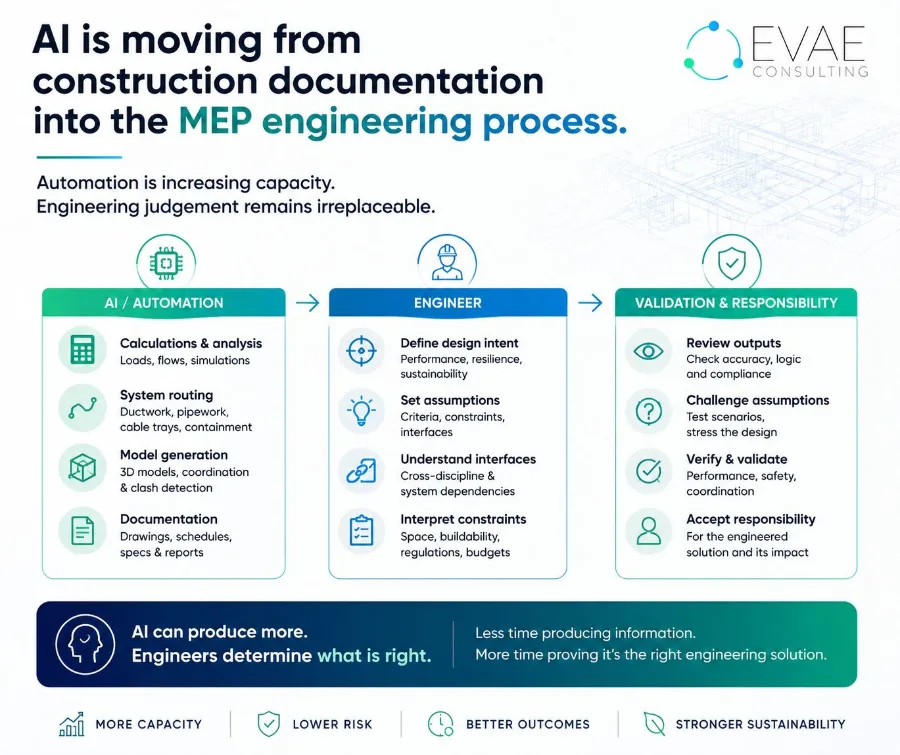
AI is moving from construction documentation into the MEP engineering process
For years, much of the discussion around AI in construction has focused on documentation, information retrieval and administrative efficiency. That is changing. Platforms such as Endra are now…
· 1 min read