
Construction
When Procurement Innovation Creates MEP Risk: Who Owns the Interfaces?
How hybrid procurement, early equipment commitments and changing design responsibilities can create hidden technical and commercial risk at the boundaries between MEP packages.
EvaE Consulting · · 9 min read
When Procurement Innovation Creates MEP Risk: Who Owns the Interfaces?
A lower MEP package price is not necessarily a lower project cost.
That distinction has become a critical battleground as construction projects and Clients increasingly use more sophisticated procurement strategies to manage commercial and program pressures. Two-stage tendering, early contractor involvement, direct equipment and packages procurement, specialist trade appointments, and consultant novation are all entirely rational choices. They get specialist knowledge into the room early, de-risk long-lead plant, and give clients direct control over high-value elements of the build.
The difficulty begins when these decisions are considered individually rather than as part of the delivery structure they collectively create.
As a project becomes more commercially sophisticated, the coordination challenge can become harder to manage. A critical MEP package might be bought early to protect the master program, even while the surrounding structural and architectural design is still fluid. A specialist vendor might be appointed directly for their technical expertise, only for their design to become part of another contractor’s delivery responsibility later. A consultant might develop a design to Stage 3 before responsibility for taking it forward changes as the project moves into procurement and delivery.
None of these procurement routes is necessarily wrong. The problem is that each additional procurement decision introduces relationships that the rest of the project has to accommodate.
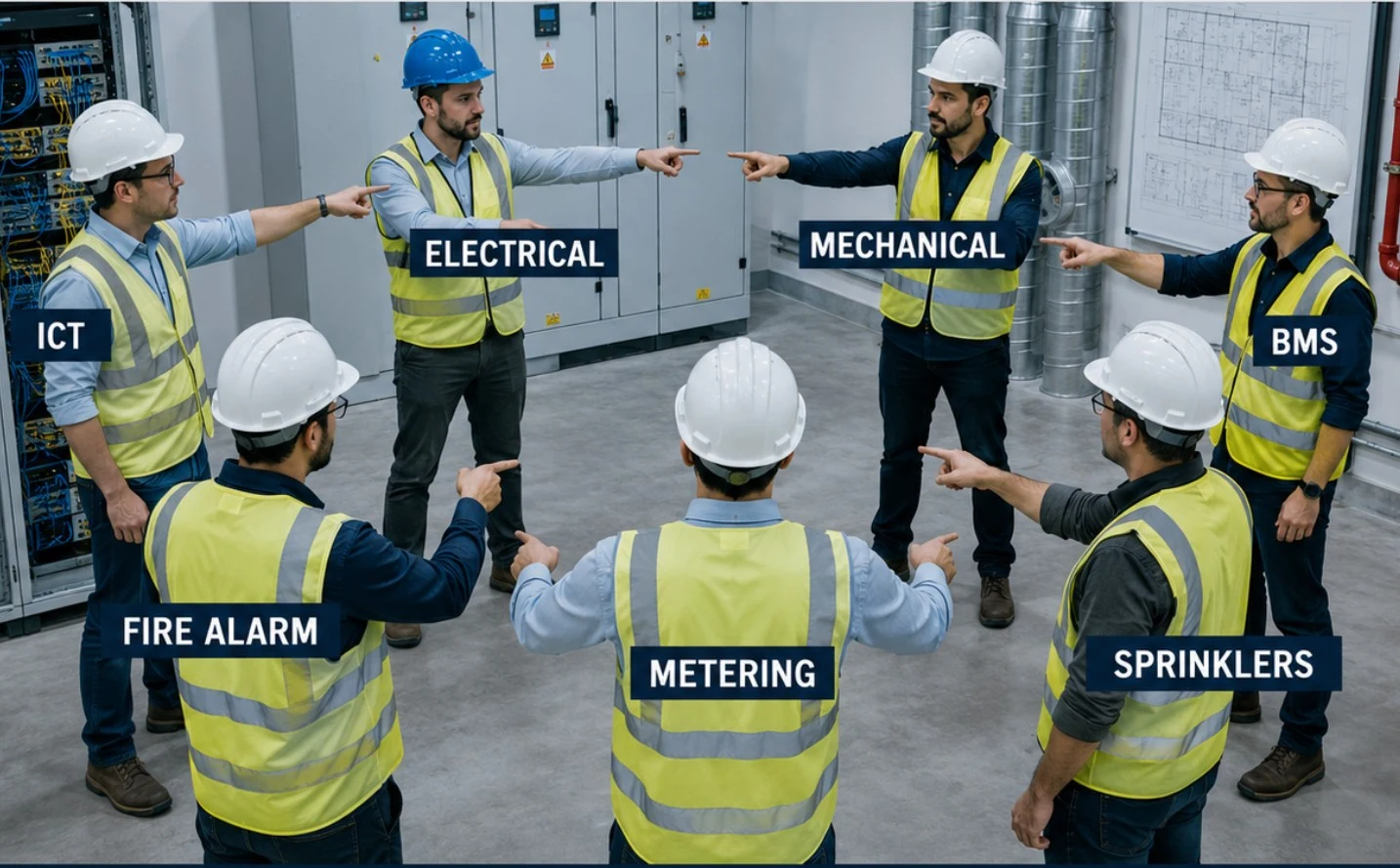
For building services, these interfaces are high-risk. A building cannot operate as a collection of isolated, neatly packaged contracts. Electrical distribution has to work with mechanical plant. Building Management Systems (BMS) have to communicate with the equipment they control. Specialist security, fire and data systems have to exchange information with the wider infrastructure.
The physical and technical boundaries drawn by a procurement team eventually have to be reconciled with how the building actually functions. This leaves project teams facing a question that is dangerously easy to ignore during the tender and post tender phases: Who owns the interface?
The Rise of Deliberate Procurement
The industry shift toward flexible procurement is a logical reaction to a volatile market. BCIS reported in January 2026 that contractor reluctance towards single-stage Design & Build remained evident, with pricing risk and limited early collaboration among the factors influencing procurement preferences. Two-stage tendering, negotiated approaches and hybrid models, where some elements are committed earlier while others remain flexible, continue to attract interest.
Similarly, RICS similarly describes procurement as a strategic project decision rather than simply a mechanism for placing a contract. In a market defined by changing costs and supply-chain conditions, procurement is one of the mechanisms through which clients manage wider project risk.
ECI can bring construction methodology and supply-chain knowledge into the design before choices become difficult to alter. Early plant procurement can be justified when a long chiller lead time threatens the critical path. Engaging a specialist subcontractor ahead of the main contract can allow its technical information to influence the developing design.
The commercial logic at the point of purchase is clean. The hangover happens during delivery.
When multiple procurement mechanisms are layered onto a single project, the traditional allocation of risk becomes harder to follow. Information flows between separate entities at different tiers. Multi-million-pound equipment is bought based on design assumptions that may shift. The scope of one trade package can become dependent on design outputs generated by another organisation.
Whether the project team intended it to or not, the procurement strategy effectively becomes the engineering strategy.
The Building Doesn’t Care About Your Package Boundaries
Take a common scenario: a client directly procures a major piece of MEP plant — say, a modular plantroom—to bypass long factory lead times. The chosen equipment is committed to the project and incorporated into the developing scheme while the surrounding mechanical and electrical designs keep evolving.
Contractually, the equipment sits in Box A, its physical installation in Box B, and its control infrastructure in Box C.
But the site doesn't have three separate engineering problems; it has one interconnected system. The plant must fit the physical space, coordinate perfectly with the connecting services, and respond accurately to the building's overarching control logic.
This is where package responsibility and interface responsibility split.
While the scope for the equipment supplier, the installer, and the BMS programmer may look crystal clear on paper, the project still lives or dies by the coordination at the exact points where those scopes collide. These boundaries look deceptively minor during procurement—a communication gateway, an interface terminal, a specific data protocol, or a tight physical tolerance.
Because packages are priced in isolation, subcontractors naturally read their obligations through the strict lens of their own tender documents. The gaps only expose themselves towards completion, when it becomes apparent how much of the connecting tissue sits in the dead space between scopes.
The technical solution may be straightforward. The commercial fallout can be considerably more difficult to resolve.
Who was supposed to price that gap? Was it explicit in the tender documents? Was the necessary terminal data available when the packages were locked down? Did the liability shift when the design moved from the consultant to the contractor?
These variations aren't born on the construction site. They are baked into the project months earlier when the procurement architecture is drawn up.
Early Procurement is a Design Decision
Buying plant early is a major design commitment, not just a procurement win.
A transformer isn't just an off-the-shelf component once the order is placed; its specific weight, footprint, and electrical characteristics instantly lock down the design parameters of the surrounding rooms and networks. A chiller establishes rigid thermodynamic, hydraulic, acoustic, spatial and energy assumptions that the developing building must absorb. The earlier you buy, the earlier those constraints become embedded in the developing design.
If waiting for full design maturity means missing the completion date, early purchasing is absolutely the right call. The critical issue is whether the project team actually tracks what they have locked in by pulling that trigger.
It requires the design team to map out the downstream dependencies created by that early purchase, ensuring those constraints remain highly visible as the rest of the building evolves around them.
Without that strict discipline, projects hit a wall. The equipment is already on the factory floor, but the structural grid shifts. The electrical design matures and changes the assumptions on which the original selection was based. The architectural layout changes, compromising maintenance access. None of this means the original equipment selection was flawed, but accommodating those changes now demands expensive variations because an early commercial decision has become an immovable physical constraint.
The upfront savings or program protection offered by early procurement quickly evaporate if the cost of managing its design tail is ignored. The real metric isn't whether early buying protects the program, but whether that program benefit outweighs the commercial exposure of freezing design assumptions prematurely.
The Friction of Changing Contractual Hands
The same vulnerability applies when design responsibility changes mid-stream.
A consulting engineer takes a design to a specific gateway before a contractor or specialist subcontractor assumes responsibility for detailed design and construction. That information is dropped into a new contractual structure, often alongside fragmented design packages produced by other tier-two specialists.
The contract legalities dictate the formal allocation of risk, but the practical engineering question remains: what did the new team actually inherit?
You can transfer a drawing package electronically in seconds. Transferring the engineering intent and the underlying design assumptions is much harder.
This is particularly acute in Design & Build (D&B) arrangements, where the "D&B" label often masks a fragmented reality. True risk allocation depends entirely on the granularity of the Employer’s Requirements, the specifics of the Contractor’s Proposals, novation agreements, schedules of exclusions, and heavily negotiated amendments.
Novation doesn’t wipe the slate clean. It alters the contractual reporting lines, but it doesn't erase the history of how that design was developed. Teams still need a brutal understanding of what data was verified, what was left as an assumption, and exactly how the design is expected to progress to site execution. Design responsibility cannot be treated as a hot potato to be passed off; it requires continuous, conscious management across contractual boundaries.
Bridging the Scope Gaps
An MEP package can be perfectly specified and still harbor a catastrophic boundary gap. This rarely happens because a scope was poorly drafted; it happens because scopes are written looking inward at a single trade, rather than outward at the dependencies between trades.
The impact is most severe in highly interactive systems. A mechanical air handling unit needs an electrical power feed and a controls interface. The chiller manufacturer needs to supply precise data sheets to the BMS specialist. A fire alarm interface relies on the mechanical ventilation system tripping in a very specific sequence. Sub-metering must talk to the central energy platform before the project can prove its performance credentials.
Every trade contractor involved can point to their contract and genuinely claim they did their job. Yet, the system fails to operate.
To fix this, teams must deploy practical engineering management tools during pre-construction, such as a comprehensive MEP Scope and Boundaries Matrix and a live Equipment Interface Register for early-bought plant or Client directly procured packages. The goal isn't to add bureaucratic paperwork, but to force physical and data connection points into the light while packages are still being competed and priced.
If this interface mapping happens early, boundaries are resolved through standard design coordination. If it is ignored until commissioning, the technical solution remains basic, but the commercial dispute will stall project handover.
The True Cost of Change Under Modern Regulation
The robustness of a procurement structure is only truly tested when a project is forced to pivot. A late spatial change, a design refinement, or a modification to one specialist trade system ripples through every connected package. On a multi-contract project, you cannot assess the impact of a change solely within the package where it originated. The team needs to know exactly which design assumption was breached, which dependent trades relied on that data, and whether the fix falls under an existing contractual obligation or demands a costly variation.
This management of change is no longer just a commercial preference; in England, it is a legal mandate for projects falling under the Building Safety Regulator (BSR) framework.
The building safety regime demands that controlled changes to agreed design documents are rigorously assessed, logged, and—in the case of major or notifiable changes—approved by the regulator before work on site can legally proceed. While this is a strict statutory requirement for higher-risk buildings, the underlying engineering discipline applies universally. Managing change is only possible when you fully map the design dependencies created by early procurement choices. If those connections are blind, you will only discover them on site when fixing them is ruinously expensive.
Executing a Coherent Hybrid Strategy
There is no need to abandon hybrid procurement. The flexibility to make different commercial decisions for different packages at different times is a major advantage in a complex market. But that flexibility requires a hyper-disciplined approach to engineering continuity.
It starts with treating procurement as an extension of design. Where design data changes hands, its maturity and limitations must be fully documented. Where an MEP package is carved out, its physical and digital boundaries must mirror real-world system architecture. Where equipment is bought early, its engineering assumptions must be tracked like a live design risk.
The commercial contracts must wrap around the engineering reality, not the other way around. If a main contractor is expected to coordinate system integration, the contract and associated preliminaries should properly reflect the resources and coordination effort required to discharge that responsibility. If a client chooses to retain direct contracts with specialist vendors, they must accept and resource the role of design integrator themselves rather than expecting the supply chain to sort it out informally.
The objective is simple: make every high-risk interface visible long before the packages are locked down. Commissioning will eventually force these systems together anyway, and while individual subcontractors remain responsible for testing their own kit, a well-managed project ensures that the connective tissue needed to make those systems perform as a single, compliant building has been priced, coordinated, and owned from day one.
A great procurement strategy doesn't pretend this complexity doesn't exist. It anticipates it.
Related insights

The hidden danger of D&B bids: Why pricing a tender shouldn't just be a numbers game
When contractors receive a Request for Proposal for a Design & Build project, the immediate pressure is simply to turn around a competitive cost proposal. It’s easy to treat the tender package purely…
· 1 min read

Net Zero Retrofit Is an Engineering Exercise, Not a Plant Replacement Exercise
Net Zero Retrofit Is an Engineering Exercise, Not a Plant Replacement Exercise The easiest way to sell building decarbonisation is to talk about what gets bolted to the floor. Gas boilers become heat…
· 11 min read
World Green Building Week 2026: Are we measuring the building we designed — or the building we actually operate?
The upcoming World Green Building Week 2026 is a useful reminder that the next challenge for the built environment is not simply designing more sustainable buildings. It is delivering buildings that…
· 1 min read