
Energy
Grid Capacity and MEP Design: What UK Developments Need to Consider
EvaE Consulting · · 7 min read
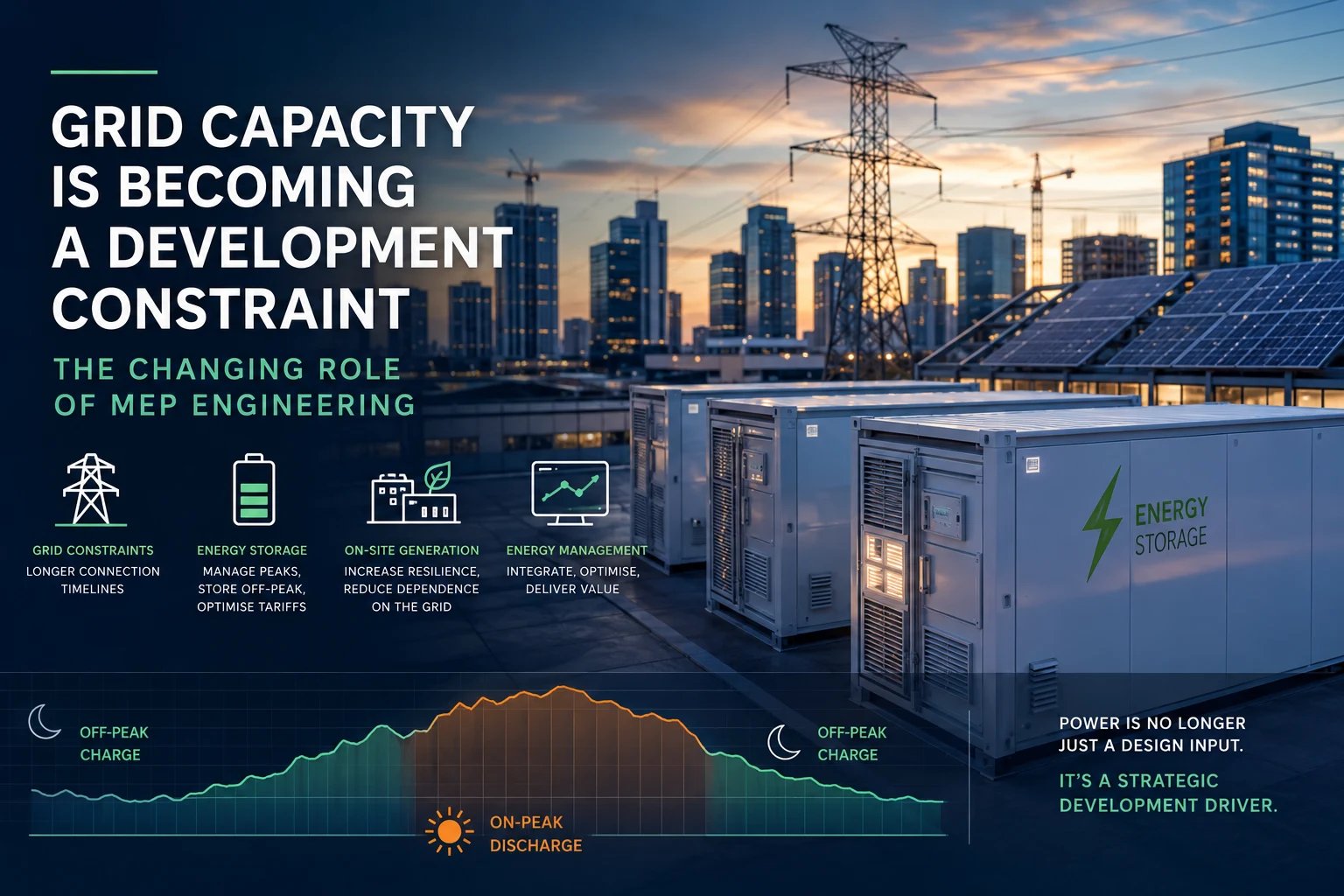
Grid Capacity as a Development Constraint: The Changing Role of MEP Engineering
The greatest bottleneck facing modern real estate development is no longer just planning permission, finance, or materials—it is the grid. The UK electricity network has rapidly evolved into a primary factor governing the viability, programme, and design strategy of major developments.
For decades, electrical capacity was treated as a routine design input: engineers established a building's maximum demand, determined the connection capacity, and coordinated with the relevant Distribution Network Operator (DNO) or transmission network. That passive model is no longer workable. As electricity demand accelerates, connection queues stall, and the electrification of heating, transport, and commercial operations gathers pace, grid capacity has transformed from a standard utility requirement into a hard development constraint.
This shift is most visible in the data centre sector. In July 2026, Ofgem announced sweeping proposed reforms to address speculative data centre projects occupying capacity within Britain’s connection queue. Demand connection applications had surged from 41GW to 125GW in less than a year, with data centre projects accounting for at least 80GW of that total. The proposed reforms introduce strict financial commitment requirements and project milestone checks to ensure capacity is reallocated to projects capable of actually progressing.
Yet the implications extend far beyond data centres. For developers, investors, contractors, and MEP consultants across all sectors, electrical capacity can no longer be treated as a simple downstream utility connection. It must be addressed at the very outset of development strategy.
From Capacity to Availability: A Strategic Paradigm Shift
Traditionally, feasibility exercises focused almost exclusively on determining how much electrical capacity a development required. While that calculation remains essential for power-intensive assets, it solves only half the equation. The more critical variable today is electrical availability—determining when that capacity can realistically be delivered to the site.
A development can possess a technically sound load profile and still face severe programme risk if local network infrastructure cannot support it within the target delivery window. Connection dates are routinely dictated by upstream reinforcement requirements, substation upgrades, protection and control works, utility construction lead times, and the progression of competing projects in the queue.
Development Strategy ──► Energy Strategy ──► Load Assessment ──► Grid Capacity
Operational Strategy ◄── MEP Infrastructure ◄── Connection Strategy ◄──┘
These connection delays directly threaten project delivery schedules. A delayed grid connection disrupts building energisation, testing, commissioning, and final occupation. In phased developments, grid constraints dictate the sequence in which individual buildings become operational. Furthermore, where electrical power drives mechanical heating, cooling, and ventilation, grid delays ripple directly into the commissioning strategy for the wider MEP installation.
The International Energy Agency (IEA) has highlighted that electricity infrastructure lead times now routinely exceed the construction schedules of the buildings themselves. As a result, the fundamental role of the electrical engineer has changed: the core question is no longer simply how to connect a building, but how to plan the entire development around the grid capacity that can realistically be delivered.
Designing Around the Load Profile
Designing a grid connection solely around a building’s theoretical maximum peak demand often leads to over-engineered, cost-prohibitive infrastructure applications. A building’s theoretical peak rarely represents its continuous operating reality; high-demand spikes are often brief and driven by the simultaneous operation of cooling plant, heat pumps, EV charging, and process loads.
When grid capacity is constrained, managing the shape and timing of the demand profile becomes as important as managing total energy consumption. Modern MEP engineering focuses on active demand management through intelligent building controls, load sequencing, time-of-use operational shifts, on-site energy storage, and localized generation. The goal is not necessarily to reduce total kilowatt-hours, but to control when and how peak power is imported from the network.
Unlocking the Multi-Value Role of Energy Storage (BESS)
As grid constraints tighten, Battery Energy Storage Systems (BESS) are evolving from simple emergency backup assets into dynamic energy management tools that interact directly with building loads, grid connections, dynamic tariffs, and on-site renewables.
1. Time-of-Use & Tariff Management
Where electricity tariffs offer lower-cost off-peak windows (such as overnight), a BESS can be programmed to charge during low-cost periods and discharge during peak hours. This shifts a significant portion of the client’s energy import away from expensive tariff windows, transforming the battery into an active energy procurement asset.
In simple terms:
Off-peak → Charge
Peak → Discharge
2. Peak Shaving & Capacity Buffer
For developments facing a constrained Maximum Import Capacity (MIC), a BESS provides real-time peak shaving. When instantaneous building demand spikes due to heavy mechanical or operational loads, the battery discharges to supplement the grid supply. This allows the development to operate comfortably within a lower capped grid allocation without sacrificing operational performance.
3. Renewable Integration
Combined with on-site generation like solar PV, energy storage prevents forced export or curtailment during low-demand periods. Surplus renewable power generated during mid-day troughs is captured and deployed during high-demand evening peaks, creating a fully integrated loop: Generation → Storage → Building Load → Grid.
The Core Engine: Integrated Energy Management Systems (EMS)
Coordinating generation, storage, and flexible building loads requires a centralized control architecture. Operating an energy storage system independently from the building management system yields limited commercial value. An integrated Energy Management System (EMS) acts as the digital orchestrator, real-time balancing multiple variables across the asset:
Controlled Vector | EMS Operational Objective |
Grid Import Limits | Prevents site demand from breaching contracted connection caps. |
BESS State of Charge | Optimizes charge/discharge cycles based on health degradation and price curves. |
Dynamic Electricity Tariffs | Automatically shifts import schedules to exploit off-peak pricing. |
On-Site Generation | Prioritizes self-consumption over grid export. |
HVAC & Flexible Loads | Pre-cools or pre-heats spaces dynamically during lower-cost energy windows. |
EV Charging Stations | Throttles or sequences charge rates during peak building operation. |
By linking these components under a unified control strategy, the building transitions from a passive consumer into an active, flexible energy asset.
Cross-Disciplinary MEP & Commercial Strategy
Integrating these technologies changes how MEP engineering is executed. Electrical infrastructure can no longer be designed in isolation from mechanical systems, space planning, or commercial viability:
HVAC & Process Alignment: Cooling strategies, heat pump selections, and EV charging profiles directly determine the magnitude and timing of peak electrical loads.
Spatial & Safety Coordination: Integrating BESS and distribution equipment requires early architectural planning for spatial footprints, ventilation, acoustic isolation, maintenance access, and strict fire safety compliance (e.g., thermal runaway mitigation and separation distances).
Whole-Life Commercial Modeling: The commercial case for energy storage and smart controls must go beyond simple capital expenditure comparisons. Feasibility evaluations must account for round-trip efficiency, battery degradation curves, replacement schedules, peak-demand penalty avoidance, tariff arbitrage, and long-term asset flexibility.
Flexible Financing: Developers are increasingly leveraging Storage-as-a-Service (SaaS) and long-term BESS leasing models. By converting CapEx into predictable operational costs (OpEx), leasing allows a development to deploy a temporary "energy buffer" from Day 1. This bridge strategy enables early asset energization and operation while waiting for long-lead grid reinforcement. Once full utility grid capacity is ultimately delivered, the BESS footprint can be rightsized, repurposed, or returned—minimizing risk and capital lock-in.
Sector-Wide Impact: Beyond Data Centres
While data centres have brought grid constraints into sharp focus, the underlying shift affects every property asset class:
Commercial Offices: Incorporating high-speed EV charging, electrified heating/cooling, and smart building controls within constrained urban connections.
Residential Developments: Navigating high concurrent demand driven by domestic heat pumps and simultaneous overnight vehicle charging.
Industrial & Logistics: Accommodating large-scale automation, electrified transport fleets, and expansive solar PV arrays behind complex private networks.
Mixed-Use Precincts: Balancing diverse, high-demand building profiles behind shared, intelligently managed site infrastructure.
Conclusion: A New Approach to Development Feasibility
The traditional development feasibility question was straightforward: "What can we build on this site?" Today, that question must be paired with an equally fundamental engineering check: "What electrical infrastructure can realistically support it, and when?"
Ofgem's proposed reforms to data centre connections are an important indication of how the UK electricity system is responding to rapidly increasing demand.
At the same time, the wider energy system is becoming increasingly flexible, with storage, distributed generation, demand management and digital controls playing a greater role alongside conventional grid infrastructure. The IEA has identified these flexibility mechanisms as increasingly important as electricity demand grows and networks face greater constraints.
At EvaE Consulting, we view this transition as a vital evolution in MEP engineering. The developments that navigate current grid bottlenecks most successfully will not necessarily be those that secure the largest raw connection caps. They will be the developments that model their energy demand accurately, manage peak loads dynamically, integrate storage and generation intelligently, and treat grid capacity as a core strategic asset from day one.
Related insights

Net Zero Retrofit Is an Engineering Exercise, Not a Plant Replacement Exercise
Net Zero Retrofit Is an Engineering Exercise, Not a Plant Replacement Exercise The easiest way to sell building decarbonisation is to talk about what gets bolted to the floor. Gas boilers become heat…
· 11 min read

World Green Building Week 2026: Are we measuring the building we designed — or the building we actually operate?
The upcoming World Green Building Week 2026 is a useful reminder that the next challenge for the built environment is not simply designing more sustainable buildings. It is delivering buildings that…
· 1 min read
When Procurement Innovation Creates MEP Risk: Who Owns the Interfaces?
When Procurement Innovation Creates MEP Risk: Who Owns the Interfaces? A lower MEP package price is not necessarily a lower project cost. That distinction has become a critical battleground as…
· 9 min read